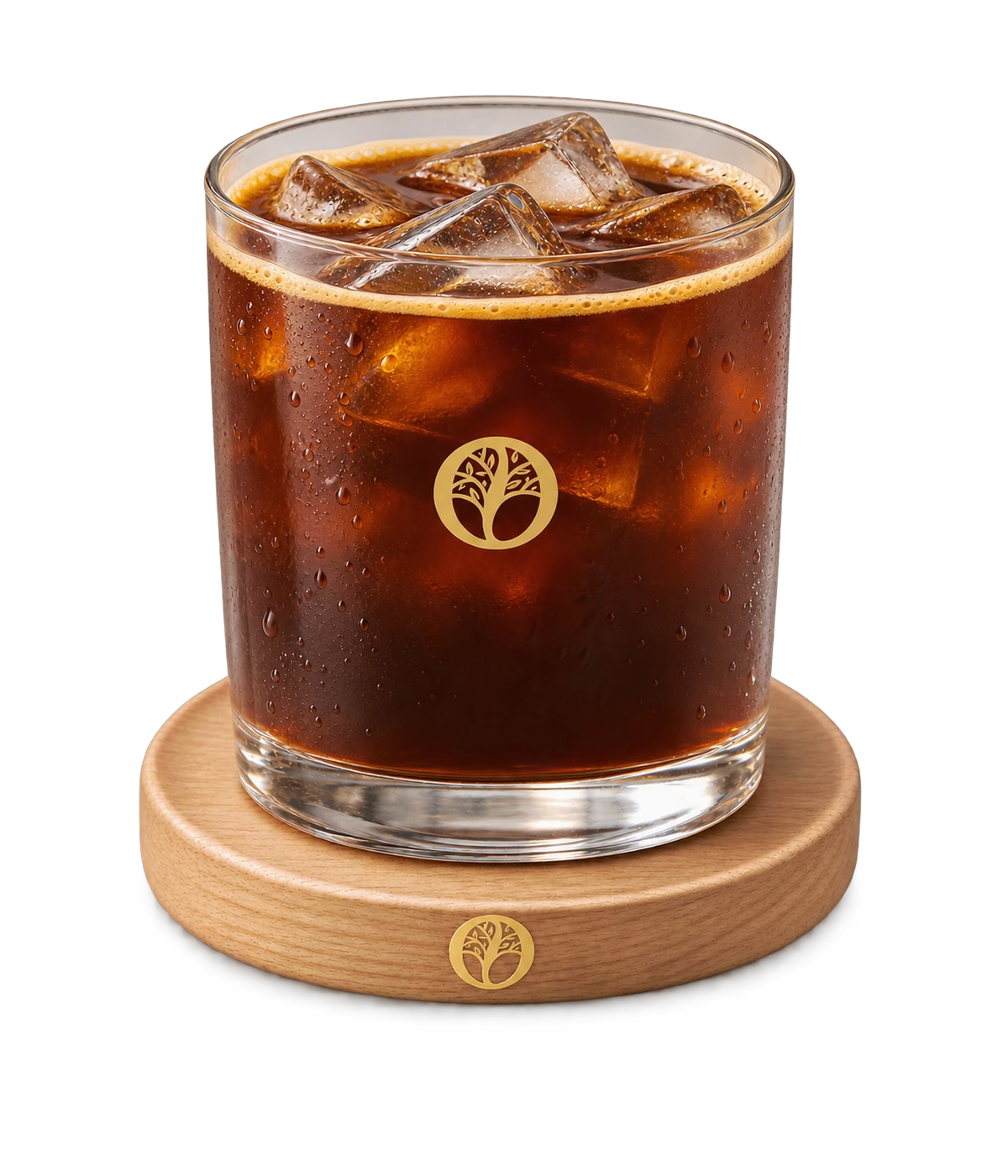
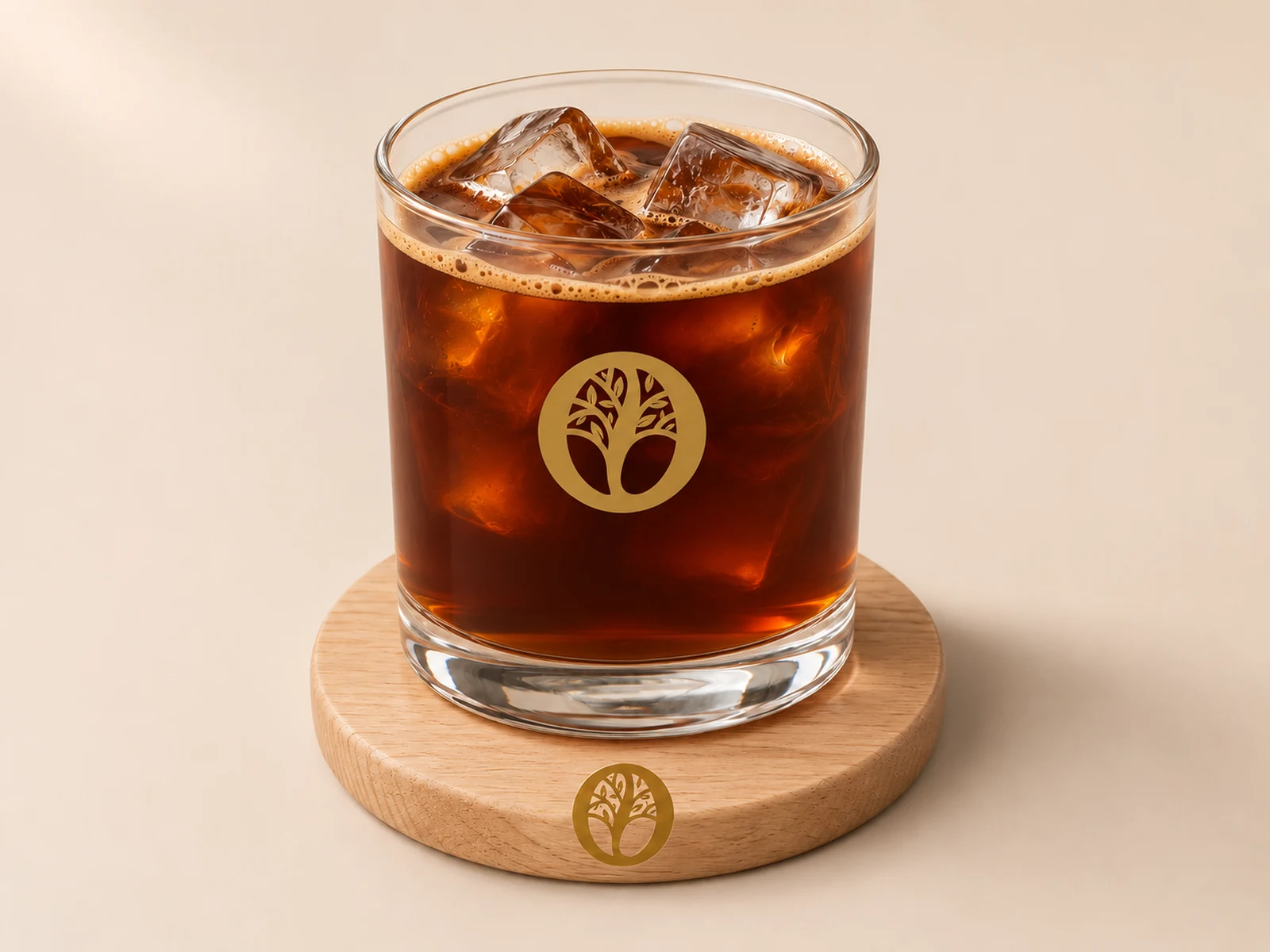
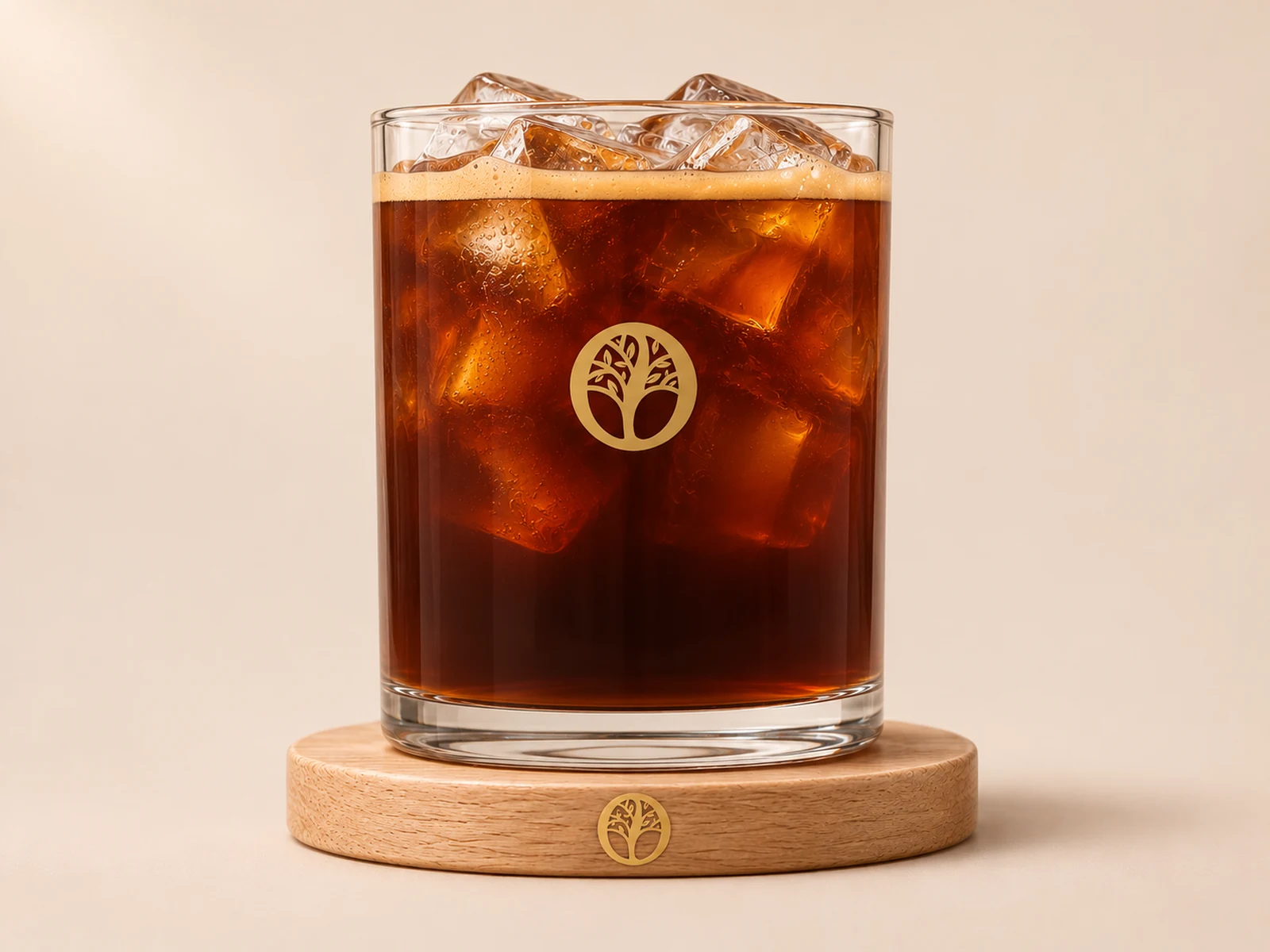
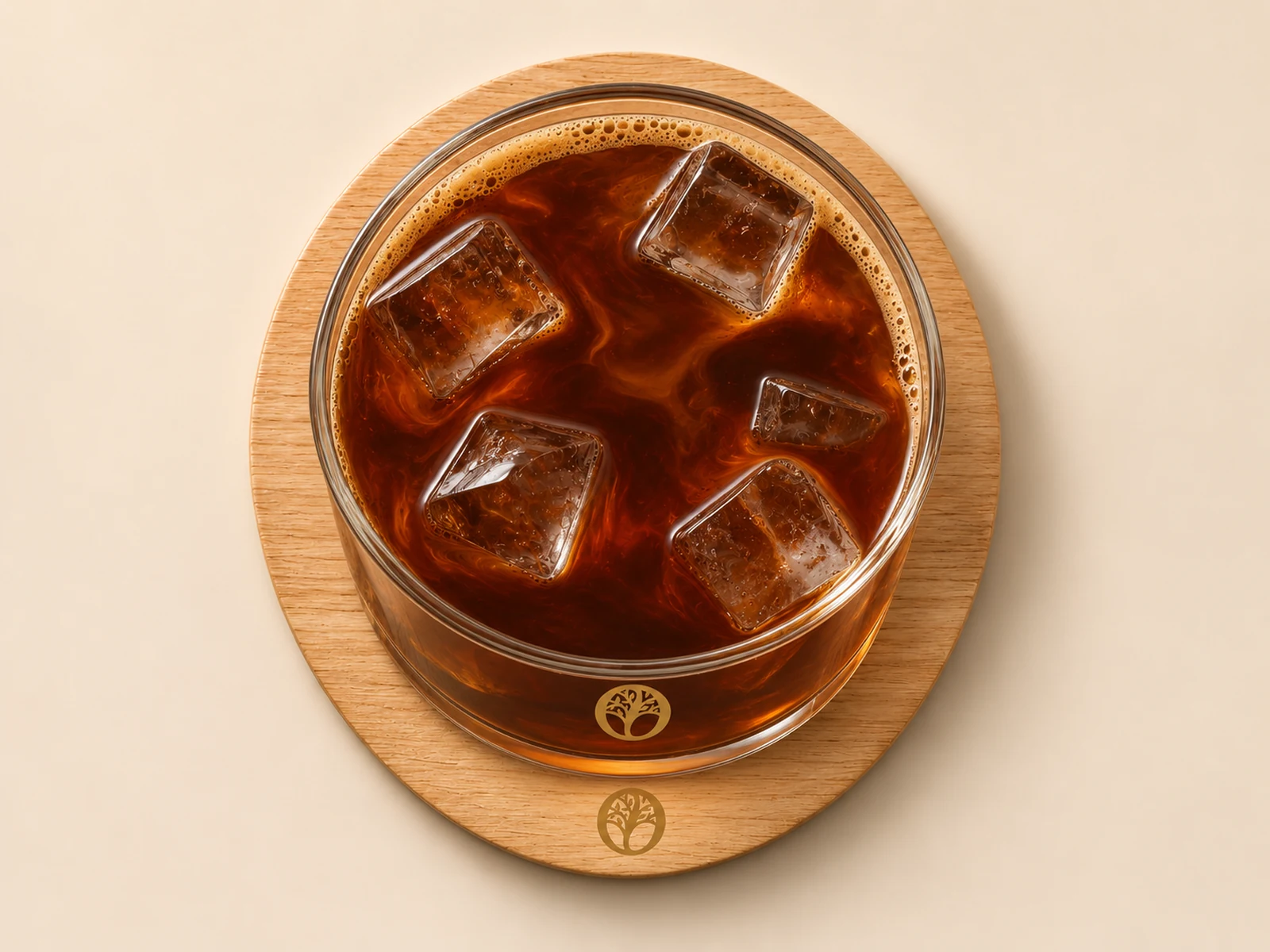
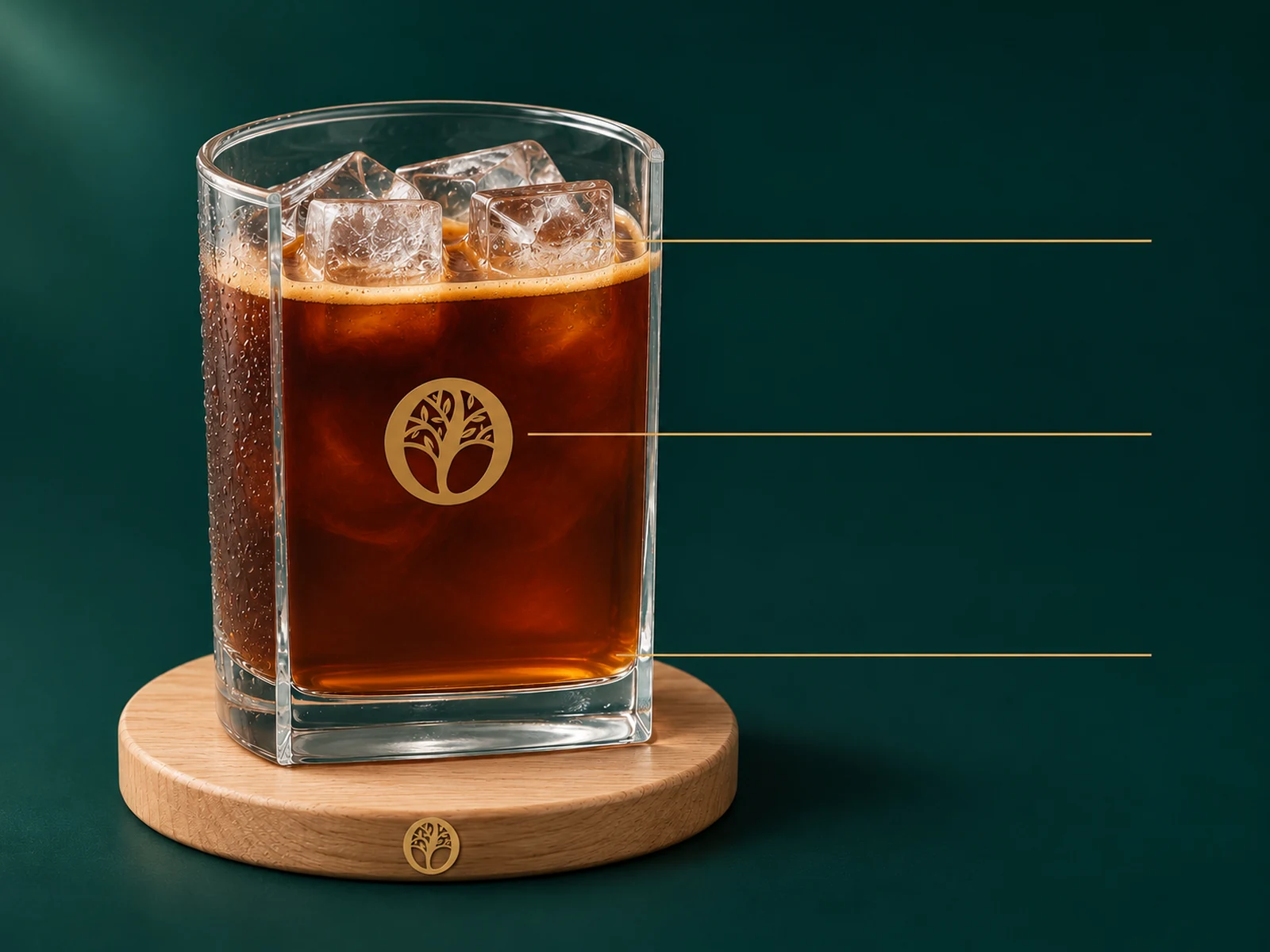
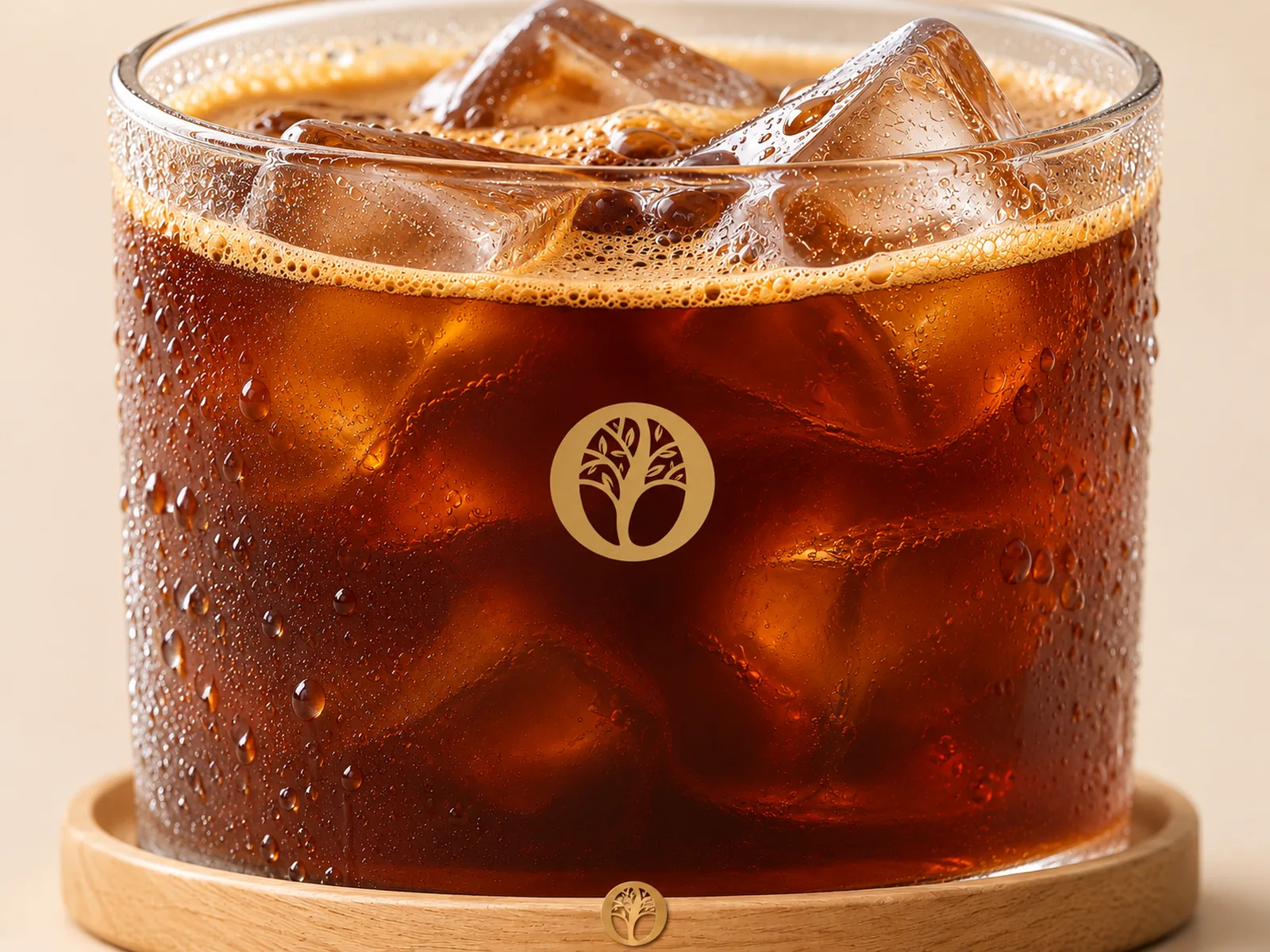
Espresso, water and clear ice: amber colour, evolving dilution and a delicate crema line.
An iced Americano opens espresso into a longer, cooler drink with water and clear ice cubes. Dark amber coffee catches the light beneath a thin light-tan crema line; there is no milk. As the ice melts, concentration changes while the espresso’s caffeine remains in the glass. Beans, roast, extraction and the water-to-coffee balance shape the result. This profile for Amberdo Cafe in Vancouver explains those relationships through chemistry and nutrition. Figures describe an illustrative unsweetened 12 oz / 355 mL serving including ice, with approximately one to two espresso shots. They depend on the recipe and are neither laboratory results nor an Amberdo nutrition declaration.
Composition
Component
Per typical serving
Notes
Espresso
30–60 mL, approximately 1–2 shots
Illustrative recipe range; the USDA nutrition model uses 29.6–59.2 g of prepared espresso, corresponding to one or two US fluid ounces [usda-espresso].
Milk
0 mL
No milk, cream or plant beverage in this reference recipe. The light-tan surface line is coffee crema, not dairy foam.
Water
Approximately 160–210 mL added cold water, plus 80–100 g ice
Illustrative recipe amounts, excluding water already in espresso. Adjust together to fit the cup; do not add the maxima. Melting ice becomes additional liquid water.
Caffeine
Approximately 60–130 mg
Rounded one-to-two-ounce estimate from USDA’s 212 mg/100 g espresso [usda-espresso]. Actual shots may fall outside it; water and ice reduce concentration, not the total dose.
Fat
Approximately 0.05–0.11 g
Calculated from USDA’s 0.18 g/100 g espresso and the reference shot masses [usda-espresso]. Trace amounts; recipe and extraction affect the result.
Sugars
Approximately 0 g
USDA’s unsweetened espresso entry reports 0 g sugars [usda-espresso]. This reference adds no sugar; syrups would change the estimate.
Protein
Approximately 0.04–0.07 g
Calculated and rounded from 0.12 g/100 g prepared espresso [usda-espresso]. Water and ice add no protein; this drink is not a meaningful protein source.
Calories
Approximately 3–5 kcal
Rounded from 9 kcal/100 g espresso at 29.6–59.2 g [usda-espresso], with plain water and ice. Recipe-dependent estimates, not Amberdo nutrition values.
Serving measurements
Caffeine
Approximately 60–130 mg0–200 mg
Calories
Approximately 3–5 kcal0–300 kcal
Protein
Approximately 0.04–0.07 g0–15 g
Each bar uses its own labelled scale; values are not comparable across units.
Coffee chemistry
Roasting, colour and flavour
Roasting generates brown melanoidins and volatile aroma compounds through Maillard and other thermal reactions. Chlorogenic acids also transform, with some products contributing bitterness. Dilution reveals a translucent amber tone; colour alone cannot quantify roast level, caffeine or acidity. [4][5]
Extraction before dilution
Hot water passing through finely ground coffee extracts soluble compounds and disperses oils. Grind, flow, temperature and beverage yield influence the mixture. Adding cold water afterwards changes concentration rather than reproducing a longer extraction through the coffee bed. [6]
Cold dilution and aroma
Melting ice absorbs heat and adds water, progressively lowering dissolved-coffee concentration. A study comparing espresso and cold brew, using fresh and stored coffee, found differences in volatile profiles and sensory characteristics. Because brewing method and temperature both varied, it does not isolate the effect of chilling an espresso or establish the aroma intensity of this recipe. [8]
The thin crema line
Espresso crema is a coffee foam containing gas, largely carbon dioxide, within a complex liquid matrix. After pouring over water and ice, it may survive as a thin light-tan line, then break up as bubbles drain and collapse. Its persistence depends on the coffee and handling; it is not milk foam or a reliable caffeine measure. [7]
Iced espresso and cold brew
An iced Americano begins with hot-extracted espresso; cold brew extracts grounds in cooler water over longer contact. Research comparing hot and cold brewing shows that pH, titratable acidity and antioxidant assays can differ independently. Serving coffee cold does not establish lower acidity or a greater health benefit. [9]
Wellbeing
Alertness
Studies suggest caffeine can temporarily improve alertness, vigilance and reaction time, largely by blocking adenosine receptors. Habitual intake and individual sensitivity affect the response. A lighter flavour after dilution does not indicate a smaller caffeine dose. [10]
Coffee polyphenols
Studies suggest chlorogenic acids and their metabolites have biological activity. Roasting, extraction and metabolism influence exposure. Antioxidant activity in laboratory systems does not establish a health benefit from one iced Americano. [5][4]
Fluid with little energy
Plain water and ice add fluid without adding calories. The reference espresso supplies approximately 3–5 kcal and only trace protein. A crossover study in men accustomed to coffee found comparable hydration measures with moderate coffee and water intake; it does not establish the same response for everyone. [3][11]
Sleep and sensitivity
Studies suggest caffeine may disturb sleep, depending on dose, timing and sensitivity. A trial using 400 mg found disruption even six hours before bed; that dose exceeds this recipe estimate and does not predict an individual response. EFSA also notes sleep effects at lower doses near bedtime. [12][2]
Health Canada recommends a maximum of 400 mg caffeine daily from all sources for most healthy adults, and 300 mg for people who are pregnant, planning pregnancy or breastfeeding. These are ceilings, not intake targets; individual tolerance may be lower. This profile is educational, not medical advice. [1]
For general information only; not medical advice. Values vary with recipe and serving size.
Serving
Serving reference for Amberdo Cafe’s profile: dark amber espresso and cold water over clear ice cubes, with a thin light-tan crema line and no milk. These are illustrative preparation details, not confirmed house service specifications.
Chilled over ice; the final temperature depends on the espresso and water temperatures, ice load and time after pouring. Ice continues to melt as the drink absorbs heat.
A nominal 12 oz / 355 mL cold-drink glass or cup; clear ice occupies part of the capacity, so liquid volume at service is lower than cup capacity.
Approximately 1 part espresso to 3–7 parts added water before ice melt. For example, 45 mL espresso, 190 mL cold water and 90 g ice give a roughly 1:4.2 liquid ratio. Adjust amounts together for ice displacement and headspace; the fully melted liquid equivalent is about 325 mL.
A closer look
Dark amber espresso and water over clear ice, with a thin light-tan crema line.Front view: translucent amber coffee, clear ice cubes and no milk.From above: clear ice interrupts a delicate line of coffee crema.Illustrated cutaway: espresso and water around ice, with a thin crema line above.A close view of clear ice edges and tiny light-tan crema bubbles.
Quality brew, great service and lovely pastries! What more to ask for on a rainy day 😌
★★★★★
Wow what a gem. Had ham and cheese croissant that was absolutely delicious! Almond croissant was very fresh and tasty! They do have professional coffee machine but i had tea. Ambiance and service are great too! And the prices are very fair to say the least. I’m surprised there isn’t a line out the door here! Absolutely recommend this place!
★★★★★
Best croissant outside of Europe
★★★★★
A lovely, quiet café with a cozy and relaxing atmosphere. The food is delicious, especially the cinnamon roll and sandwich. The coffee is very smooth.
★★★★★
Beautiful café run by an incredibly friendly family! Had an oat milk latte, and it was excellent. Highly recommend!
★★★★★
Thank you for the wonderful café you’ve created; your coffee and pastries are exceptional.
★★★★★
Best cafe in the area Very lovely place and good quality
★★★★★
Super good perfect balance of matcha milk coffee and sweetness please don’t ever change hahah